


Curl the Wrists in the Snatch & Clean?
Should you curl the wrists in the first and second pull of the snatch and clean?
The rationale for flexing the wrists in the pull is keeping the bar close to the body.
But that can move the bar an inch or so at the most… it’s inherently very limited.
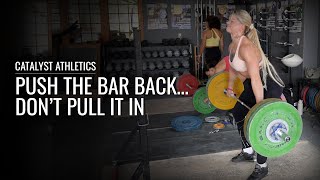
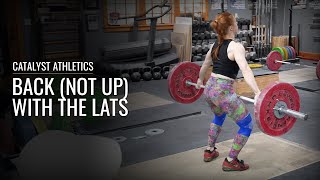
Bar proximity should be maintained with the combination of proper posture and balance, and the continuous tension of the lats that prevents the bar from swinging forward to hang under the shoulders when they’re in front of the rest of the body.
The wrists should be flexed as you pull under the bar—but this happens naturally if you’re actively pulling down under the bar with the arms like you should. It’s not something you need to do intentionally and directly, and it has nothing to do with the first and second pulls.
Flexing the elbow by pulling with the arms naturally makes the wrist want to flex, but also the bar is pulling the hands down as the arms rotate up—and you’re not doing wrist extensions with that much resistance.
Note that you’ll sometimes see some wrist flexion starting in the second pull—but nearly always that will be coupled with the lifter starting to bend the elbows. This is the same naturally linked flexion that happens in the third pull, not something that needs to be done intentionally.
Short version—keep the bar close with posture, balance and lat tension, and let the wrists flex naturally if and when they do.
I’ll repeat it again… there are exceptions to every rule. There are elite lifters who curl their wrists through nearly the entire pull, and they’re doing fine. This isn’t the detail that’s going to make you great or keep you from being great—but it’s one of many that will contribute.
Does it hurt to ALSO flex your wrists if you’re doing the rest to keep the bar close? Yes, potentially.
It’s a weak point in the chain that may extend as you accelerate, meaning less of that leg and hip force you’re generating is transmitted to the bar.
Is this guaranteed to happen, and is it going to have a big impact? No to both. But if curling the wrists is totally unnecessary and offers no benefit that can’t be achieved with a better method, there’s no reason to take the risk.
And remember that the same lat tension that helps you keep the bar close is also helping set your back into a rigid, solid position as you pull—so that action should already be happening, meaning if the bar isn’t staying close, you also likely don’t have your trunk locked in as well as you should. And curling your wrists sure isn’t going to help that.
A secondary reason given for curling the wrists is to secure the grip better. If this feels necessary to you beyond a slight degree, it’s most likely because you’re gripping incorrectly—usually trying to keep the bar too deep in the palm. Grip properly and the wrist will hang in its natural orientation with the bar perfectly secure.
The rationale for flexing the wrists in the pull is keeping the bar close to the body.
But that can move the bar an inch or so at the most… it’s inherently very limited.
Bar proximity should be maintained with the combination of proper posture and balance, and the continuous tension of the lats that prevents the bar from swinging forward to hang under the shoulders when they’re in front of the rest of the body.
The wrists should be flexed as you pull under the bar—but this happens naturally if you’re actively pulling down under the bar with the arms like you should. It’s not something you need to do intentionally and directly, and it has nothing to do with the first and second pulls.
Flexing the elbow by pulling with the arms naturally makes the wrist want to flex, but also the bar is pulling the hands down as the arms rotate up—and you’re not doing wrist extensions with that much resistance.
Note that you’ll sometimes see some wrist flexion starting in the second pull—but nearly always that will be coupled with the lifter starting to bend the elbows. This is the same naturally linked flexion that happens in the third pull, not something that needs to be done intentionally.
Short version—keep the bar close with posture, balance and lat tension, and let the wrists flex naturally if and when they do.
I’ll repeat it again… there are exceptions to every rule. There are elite lifters who curl their wrists through nearly the entire pull, and they’re doing fine. This isn’t the detail that’s going to make you great or keep you from being great—but it’s one of many that will contribute.
Does it hurt to ALSO flex your wrists if you’re doing the rest to keep the bar close? Yes, potentially.
It’s a weak point in the chain that may extend as you accelerate, meaning less of that leg and hip force you’re generating is transmitted to the bar.
Is this guaranteed to happen, and is it going to have a big impact? No to both. But if curling the wrists is totally unnecessary and offers no benefit that can’t be achieved with a better method, there’s no reason to take the risk.
And remember that the same lat tension that helps you keep the bar close is also helping set your back into a rigid, solid position as you pull—so that action should already be happening, meaning if the bar isn’t staying close, you also likely don’t have your trunk locked in as well as you should. And curling your wrists sure isn’t going to help that.
A secondary reason given for curling the wrists is to secure the grip better. If this feels necessary to you beyond a slight degree, it’s most likely because you’re gripping incorrectly—usually trying to keep the bar too deep in the palm. Grip properly and the wrist will hang in its natural orientation with the bar perfectly secure.